


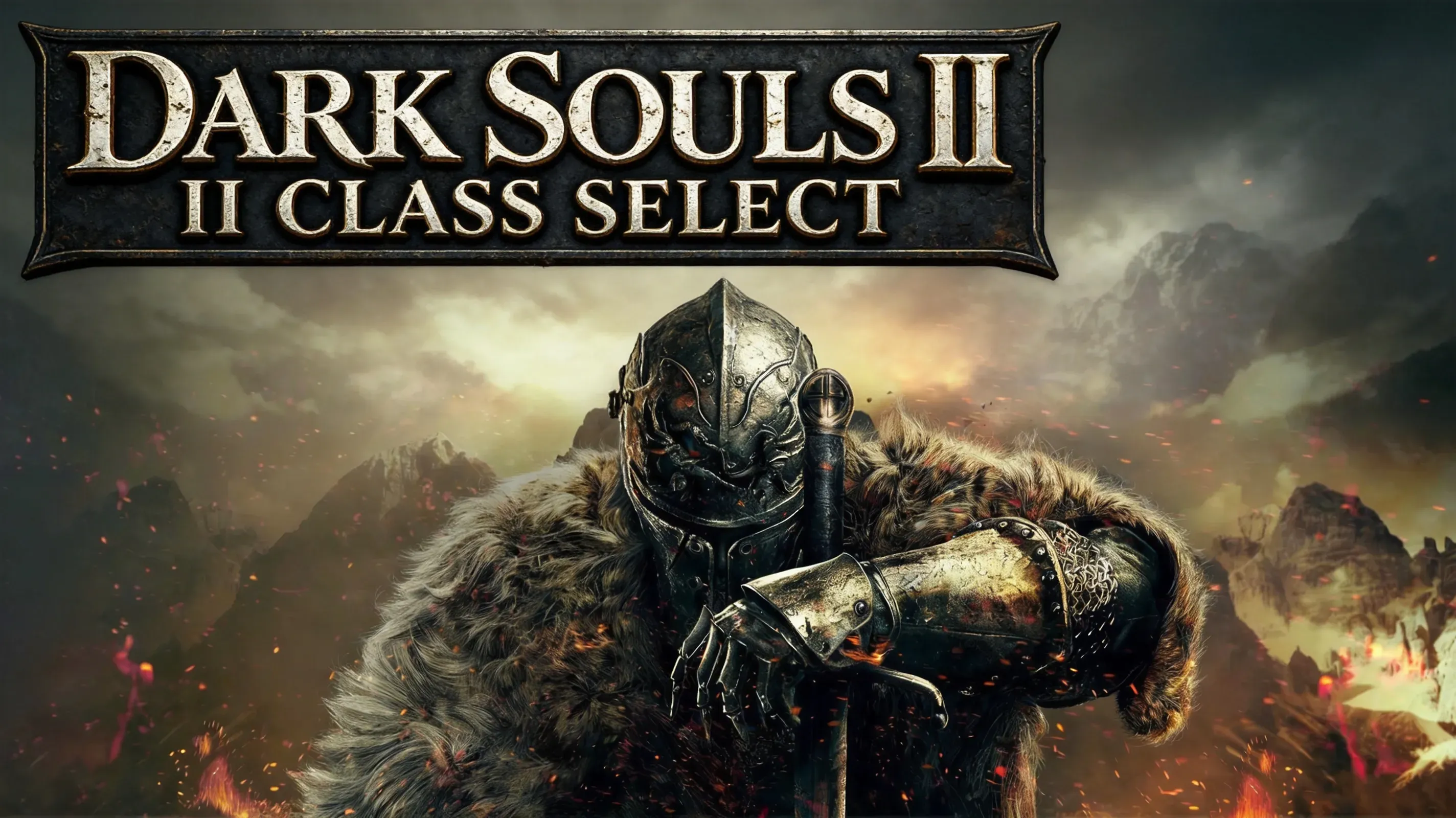
Roughly 60% of first-time Dark Souls II players quit before the Last Giant ever falls, according to 2026 community survey data — and the usual cause is not the Pursuer, but a starting class that fights the player's instincts. This guide breaks down official SotFS v1.02 (Calibrations 2.02) stat data to highlight the best starting class options for beginners in 2026, while keeping the focus on practical first-run survival rather than niche optimization.
Top 3 Recommended Starting Classes for Beginners
The Knight remains the lowest-frustration pick for the first ten hours. Its 12 VGR is the highest starting HP pool in the game, and 9 ADP gives more roll i-frames than seven of the eight other classes. The Broadsword swings wide enough to clear the trash packs that punish narrow thrusting weapons, while balanced 11 STR / 8 DEX keeps every physical path open, so no early level is wasted. One catch: the Knight does not start with a shield, so beginners must learn to roll from minute one.
The Sorcerer suits players who prefer killing enemies from 15 meters away. It opens with 14 INT, 12 ATN, and 30 Soul Arrow casts — enough to clear most of Forest of Fallen Giants without entering melee range. Magic scaling holds up across the entire run, making it a genuinely forgiving long-term pick. The trade is brutal, though: 5 VGR means most early bosses two-shot the player, so a single positioning mistake costs a full retry.
Rolling Deprived puts every stat at 6 and the starting level at 1, so early level-ups cost almost nothing and the player can pivot into anything after 20 minutes of scavenging in Things Betwixt. That is total flexibility with zero safety net, and it is explicitly not recommended for a first playthrough.
| Class | Key starting stats | Main strength | Main risk |
|---|---|---|---|
| 🛡️ Knight | 12 VGR, 9 ADP, 11 STR / 8 DEX | Highest HP, strong roll i-frames, wide Broadsword | No starting shield |
| 🧙 Sorcerer | 14 INT, 12 ATN, 30 Soul Arrows | Safe ranged clear, long-term magic scaling | 5 VGR, very fragile |
| 🪓 Deprived | All stats 6, level 1 | Cheap early levels, total build freedom | No safety net, poor first-run choice |
Quick Breakdown of Niche Starting Classes
These five classes serve specific playstyles better than the top three — usually for returning players picking up SotFS for the first time in 2026.
| Class | Notable stats | Why it works |
|---|---|---|
| ✨ Cleric | Level 14, 12 FTH | The Mace is a top-tier strike weapon, and Heal stretches Estus; the natural Faith opener. |
| 🧭 Explorer | Level 10, 12 ADP, 20 Lifegems | Best raw Agility start plus a Traveling Merchant Hat for item discovery. |
| ⚔️ Warrior | Level 12, 15 STR | The only early shield, a Broken Round Shield, for block-first players. |
| 🗡️ Swordsman | 16 DEX, +1 Scimitar, +1 Shortsword | Dual-wield glass cannon on just 4 VGR. |
| 🪨 Bandit | 11 VIT, 1 INT | Highest starting equip load for heavy armor, but locks the player out of magic for a long while. |
Critical Post-Class Selection Tips for New Players
The class pick matters less than the first 10 levels. Unlike DS1 or DS3, dodge i-frames in Dark Souls II are governed by Agility (AGL), raised mainly through Adaptability (ADP). Pushing AGL to 96–99 before touching damage stats makes rolls actually dodge, which is the single most important early-game adjustment for beginners.
-
🎁 Take Healing Wares or the Life Ring as the starting gift. The Petrified Something gamble is entertaining, not beginner-friendly, and a wasted slot on a first run stings.
-
💀 Budget for the death tax: each death shaves maximum HP down to 50%. Burn a Human Effigy before a boss the player expects to lose to repeatedly, rather than after the fifth wipe.
-
📈 Treat the first ten levels as a survival budget, not a damage race. Early ADP and Vigor investments smooth out the learning curve far more than raw Strength or Dexterity.
In 2026, SotFS remains the only version with live servers, so newcomers should verify that they are starting on the right version before committing. For a first playthrough, the Knight offers the safest baseline, the Sorcerer provides a forgiving ranged route, and the Deprived should stay in reserve for experienced players. The niche classes are excellent when they match a specific instinct — Faith support, shield-first blocking, dual-wield aggression, or heavy-armor tanking — but the best starting class is ultimately the one that lets a beginner survive long enough to learn the real lesson of Dark Souls II: Agility first, damage later.
As you venture deeper into Drangleic, managing your scaling breakpoints, weapon upgrades, and intricate NPC questlines will inevitably require quick fact-checking. Consulting the community-curated Dark Souls II: Scholar of the First Sin Wiki is an essential habit for verifying precise item drop locations, agility thresholds, and boss weaknesses before spending your hard-earned souls.
For those still looking to embark on this punishing journey or invite a co-op partner along, trusted gaming marketplaces like LootBar make it seamless to pick up game keys and digital balances. Armed with reliable reference guides and a solid early build, surviving the perils of the kingdom becomes a far more rewarding conquest.
Before picking up an extra copy for a friend or jumping into the definitive edition yourself, it pays to verify that you are getting the best deal available across storefronts. Checking the Dark Souls II: Scholar of the First Sin price history through LootBar allows you to track market trends and see how current key offers compare to past seasonal lows. By timing your purchase smartly, you can secure your entry into Drangleic at the lowest rate and focus all your energy on mastering the journey ahead.

 English
 French
 Spanish
 Portuguese
 Deutsch
 Turkish
 Dutch
 Italiano
 Russian
 Romaian
 Portuguese (Brazil)
 Greek